Shares, structures and company ownerships.
A cap table kept from the first share on, and the companies, holdings and people behind it, drawn with the ownership maths.
Price a round before you commit to it.
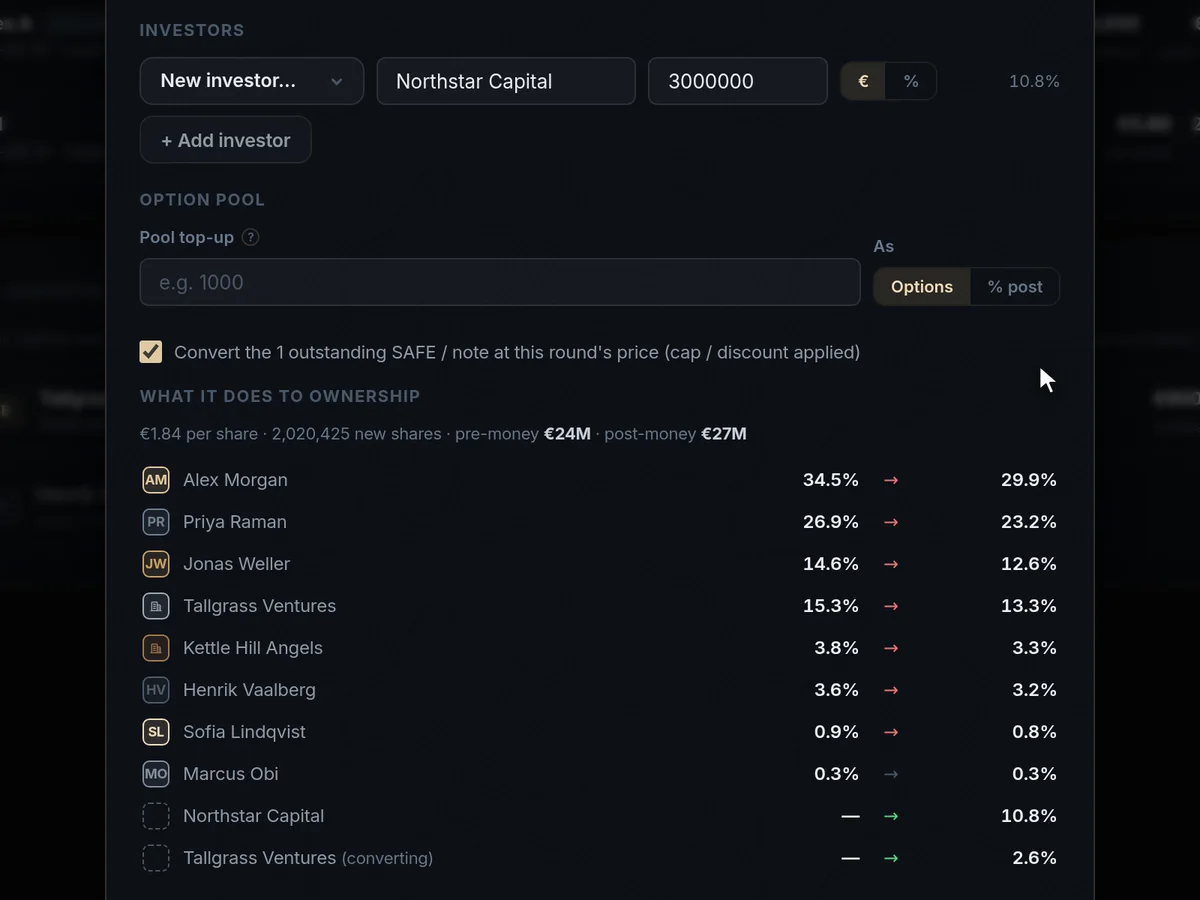
Enter the new money and the valuation and watch what it does to every holder as you type: the price per share, the new shares, the post-money, and each stake before and after. Outstanding SAFEs and notes convert at the round’s price, caps and discounts applied.
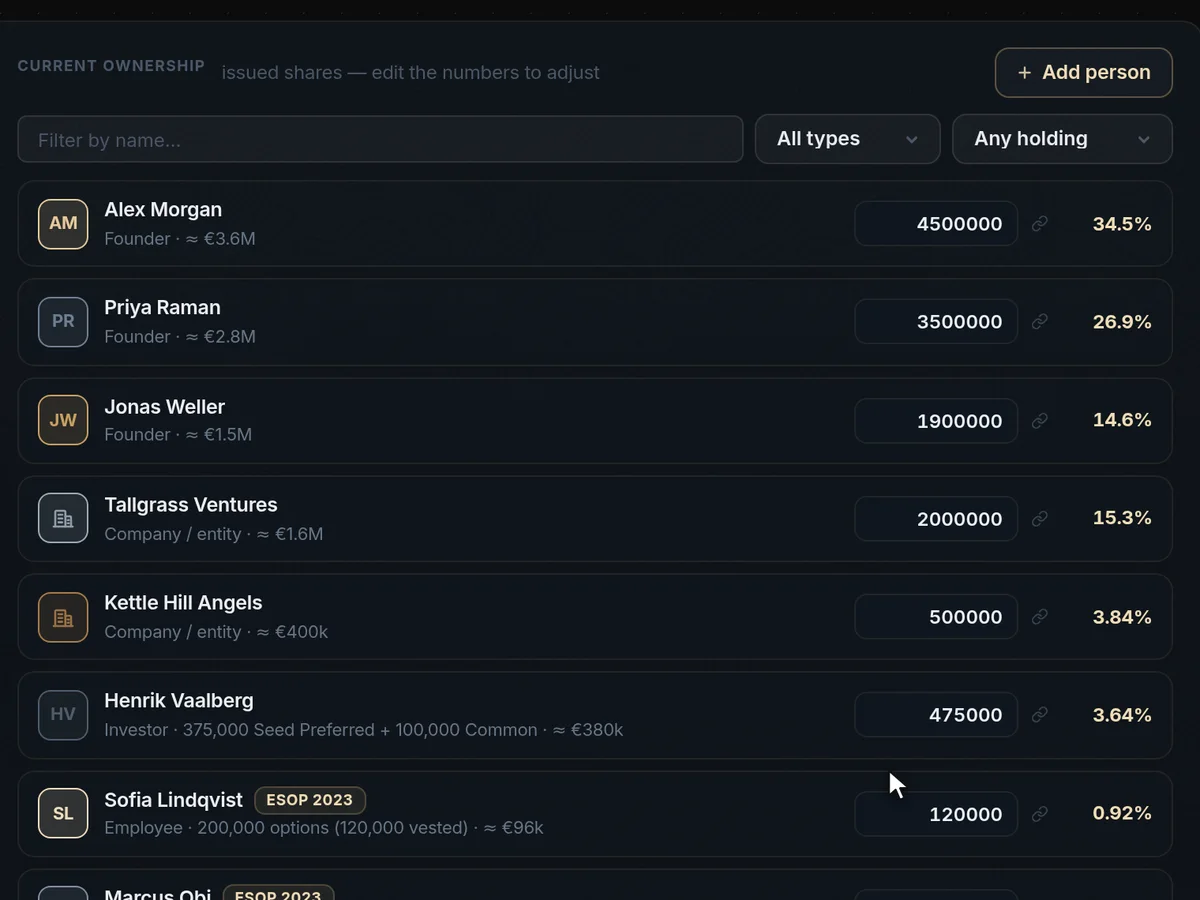
Change the table, and the maths follows.
Set a holder’s percentage straight on the cap table. Engine117 works out the shares to issue, rebalances everyone else and records the change as an event in the ledger — so the split you see is always the one the ledger adds up to.
The structure behind the shares.
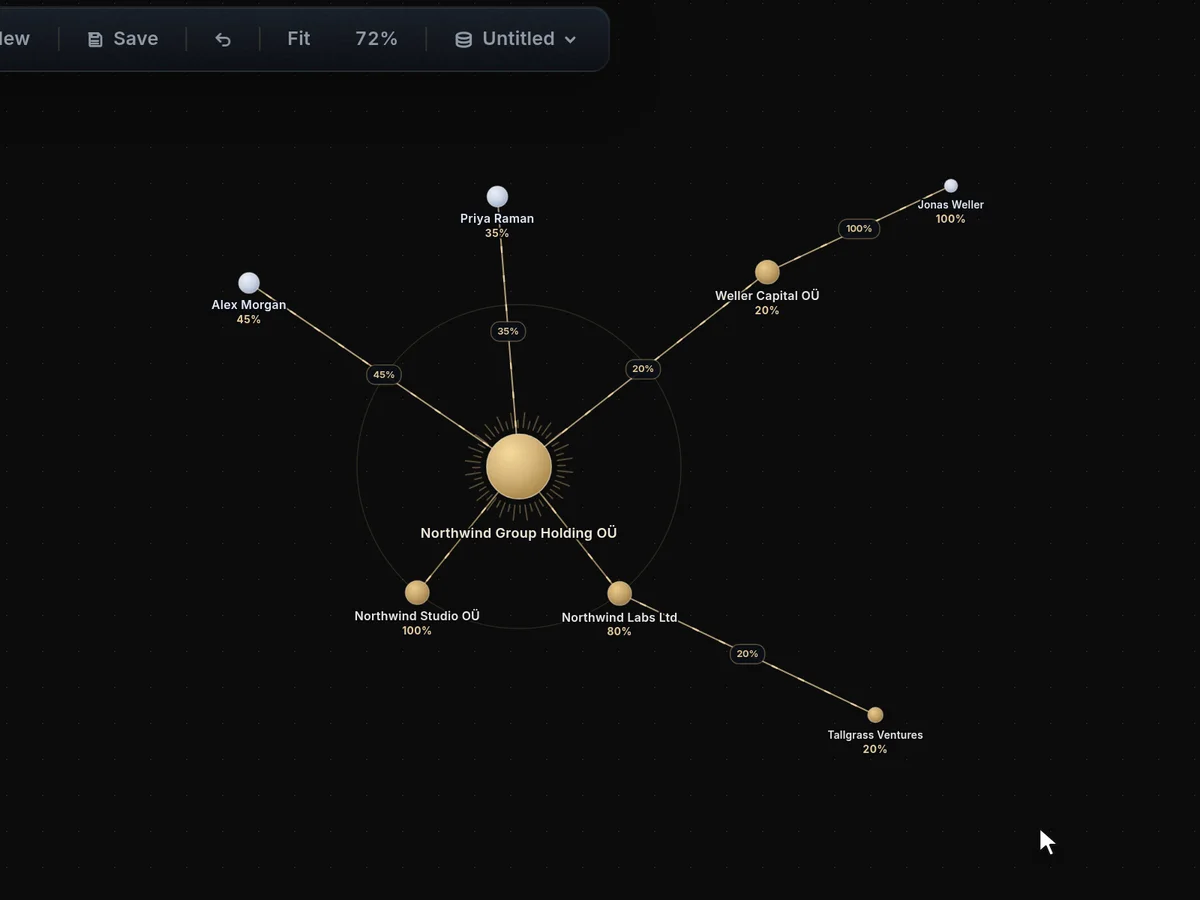
Draw the group as it really is: holding companies, subsidiaries and the people who own them, with the percentages on every link. Click a company to see who owns it, what it owns, its ultimate beneficial owners and how much of its equity is allocated.
Shares and structures, answered
What is the ownership module?
Cap table software that keeps your share register from the first share on, with the companies, holdings and people behind it drawn as a structure.
See who owns what on any date, track options as they vest, model the next round before you commit, and map the group with the percentages on every link.
It replaces the cap-table spreadsheet that drifts out of date, the slide with the group structure that nobody updates, and the scramble to work out beneficial owners when a bank or investor asks.
Can we model a funding round?
Yes. Enter the new money and the valuation and see the price per share, the new shares, the post-money and every holder’s stake before and after, as you type.
Outstanding SAFEs and convertible notes convert at the round’s price with their caps and discounts applied. Keep the result as a scenario until you are ready.
Keep a round as a scenario and come back to it before a term sheet is signed, to see exactly how much each founder and investor would own afterwards.
Does it track options and vesting?
Yes. Record option grants with their vesting period and cliff, and see what has vested on any date.
Grants sit on the same cap table as the shares, so dilution includes them.
How does it find our company?
Add your company and Engine117 looks it up in the public registers first. Direct register lookups cover Estonia, Norway, Finland and Switzerland; elsewhere it searches public sources.
Some countries, such as Germany and most US states, do not publish shareholders. You can then enter the holders yourself and the maths takes it from there.
Where a register publishes shareholders, the cap table can be started from it instead of being typed in, and you correct anything that is out of date.
What happens when we change a holding?
Set a holder’s percentage straight on the cap table. Engine117 works out the shares to issue, rebalances everyone else and records the change in the ledger.
The split you see is always the one the share ledger adds up to, and the history is kept as events.
Because changes are events, you can look at the cap table as it stood on any past date, which is what investors, auditors and lawyers usually ask for.
Can we see ultimate beneficial owners?
Yes. Click a company in the structure to see who owns it, what it owns, its ultimate beneficial owners and how much of its equity is allocated.
Holding companies, subsidiaries and the people behind them are drawn as they really are.
Can we export the cap table?
Yes, as a CSV as it stood on any date you choose.
Useful for investors, lawyers and due diligence.
Is it suitable for startups and holding companies alike?
Yes. Startups use it for the cap table, options and rounds; holding companies and family offices use it to map the group and its beneficial owners.
Both use the same share ledger underneath, so a startup that grows into a group does not have to change tools.
Who can see the cap table?
Only the people you grant access to. Ownership data is usually restricted to owners and a few admins, and every view setting change is logged.
Viewers can be given read-only access, for example for an adviser.